
Few figures in modern British politics have sparked as much passion, debate, and division as Jeremy Corbyn. To some, he’s a man of principle — a lifelong campaigner who dared to challenge the status quo. To others, he’s a symbol of political naivety, whose idealism cost Labour a historic defeat. Yet love him or loathe him, Corbyn’s impact on the national conversation is undeniable.
From the Grassroots to Westminster
Born in 1949 in Wiltshire, Jeremy Corbyn grew up in a politically engaged household. His parents were peace activists, and that early exposure to protest culture would shape the trajectory of his entire life. After leaving school, he became active in trade union organizing and anti-apartheid movements — causes that reflected his deep commitment to social justice and international solidarity.
Corbyn was first elected as the Labour MP for Islington North in 1983, and for decades he occupied the backbenches, often voting against his own party leadership. During the height of Tony Blair’s “New Labour” era, Corbyn was seen as a relic of the old left — an unyielding socialist in a party increasingly comfortable with market economics. But while he was ignored by Westminster elites, he built a quiet reputation among activists as someone who never sold out.
The Accidental Leader
When Labour faced a leadership crisis after its 2015 general election loss, few expected Corbyn to be more than a symbolic candidate. He barely scraped onto the ballot, nominated by MPs who wanted to “broaden the debate.” What happened next stunned the establishment: hundreds of thousands of new members and supporters flooded into Labour, energised by Corbyn’s plainspoken honesty and anti-austerity message.
His campaign slogan — “For the many, not the few” — resonated with a generation disillusioned by inequality, housing insecurity, and stagnant wages. By September 2015, the unthinkable had happened: the backbencher from Islington North was now the leader of the Labour Party.
Hope and Heartbreak
Corbyn’s leadership sparked a political movement. His rallies drew thousands; his speeches offered a vision of Britain built around fairness, compassion, and public ownership. In 2017, Labour defied expectations by increasing its vote share and depriving Theresa May’s Conservatives of a majority. Suddenly, “Corbynism” looked like it could win.
But the momentum didn’t last. Internal party divisions deepened, Brexit tore through Labour’s coalition of voters, and accusations of antisemitism within the party became a running scandal. Critics accused Corbyn of failing to act swiftly or decisively, while his supporters argued that he was being unfairly targeted by political opponents and parts of the media.
The 2019 general election brought everything crashing down. Labour suffered one of its worst defeats in nearly a century, losing dozens of long-held seats. Within months, Corbyn stepped down as leader — replaced by Keir Starmer, who promised to rebuild Labour’s credibility with the electorate.
Beyond Labour
Many assumed that Corbyn’s political career would fade quietly. They were wrong. In 2020, he launched the Peace and Justice Project, a platform to champion grassroots activism, climate justice, and workers’ rights. His message — that politics should serve ordinary people, not corporate interests — continued to inspire a devoted following.
By 2024, after tensions with Labour’s leadership over his handling of the antisemitism controversy, Corbyn was barred from standing as a Labour MP. Instead, he ran as an independent in Islington North — and won, decisively. The result confirmed that, despite establishment resistance, Corbyn remained deeply rooted in his local community and among the left-wing faithful.
Now, in 2025, he’s helping to build Your Party, a new left-wing movement alongside younger MPs like Zarah Sultana. Whether this fledgling organisation can challenge Britain’s two-party dominance remains to be seen — but it’s clear Corbyn has no intention of retiring from the political fight.
A Complicated Legacy
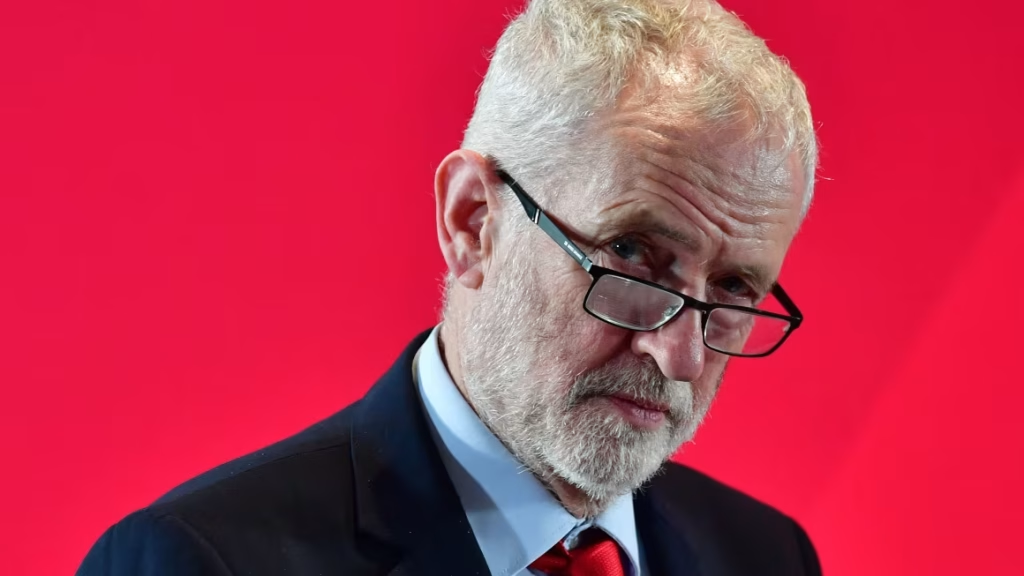
Jeremy Corbyn’s story is one of resilience, conviction, and contradiction. He transformed Labour’s internal politics, inspired a new generation of activists, and dragged public debate leftward on issues like climate policy, nationalisation, and wealth inequality. At the same time, his leadership exposed deep divisions on the British left — between idealists seeking transformation and pragmatists chasing electability.
His critics see a man who mistook protest for politics. His admirers see a leader who dared to speak truth to power. Either way, Jeremy Corbyn remains a reminder that politics is about more than just winning elections — it’s about vision, values, and the courage to stand by them, even when the world tells you not to.